
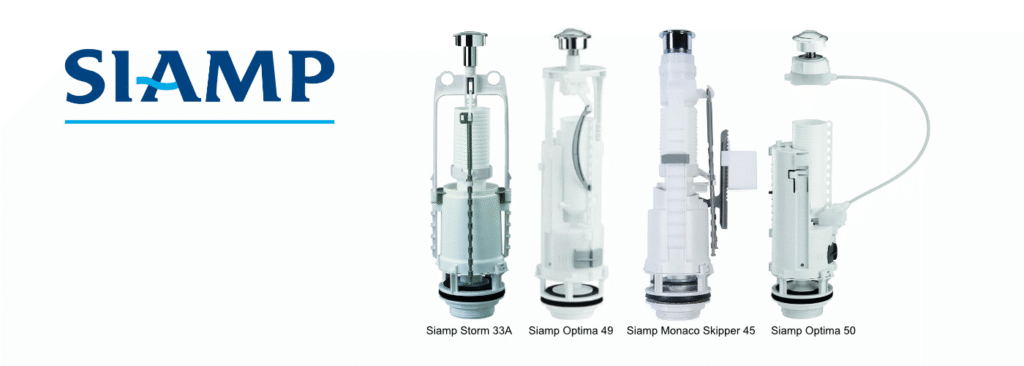
Identification, Design and Common Problems
The SIAMP Storm 33A flush valve is a dual-flush tower-style mechanism used in many modern close-coupled toilet cisterns. It forms part of Siamp’s family of push-button operated flushing systems designed to provide efficient water usage while maintaining reliable flushing performance.
The Storm 33A is typically installed centrally inside the cistern and is operated by a push button mounted through the lid. The mechanism uses a vertical lift rod connected to the control button to raise the valve and release water during a flush.
SIAMP 32335510 33A Storm Flush …
Like many modern flush valves, the Storm 33A is designed to deliver both a full flush and a reduced flush depending on how the mechanism is configured. It has been used in a wide range of toilet cisterns and is often encountered when diagnosing flushing problems in modern bathrooms.
Buttons and Operating Systems Associated With the Storm 33A
The Storm 33A is normally operated using a push-button mounted through the cistern lid.
This button screws through the lid and connects to the flush valve via a central lift rod mechanism. When the button is pressed, the rod lifts the internal plug assembly and allows water to discharge from the cistern into the pan.
Some installations may also use a related mechanism known as the Switch 22A, which works in a similar way but uses a push-to-start and push-to-stop flushing system.
SIAMP 32335510 33A Storm Flush …
As with many push-button systems, the button must usually be unscrewed before the cistern lid can be removed, as it passes directly through the lid and attaches to the operating mechanism inside.
Because many manufacturers produce similar chrome push buttons, the button design alone is not always enough to positively identify the flush valve.
Identifying the Storm 33A Inside the Cistern
Once the cistern lid has been removed, the Storm 33A can usually be recognised by its tall cylindrical tower-style body positioned over the outlet hole in the base of the cistern.
The mechanism contains a central overflow tube and lift rod assembly, which connects directly to the push button above. Around the top of the mechanism sits a metal or plastic support frame (often referred to as the stirrup) that stabilises the lift rod and helps guide the flushing action.
At the bottom of the valve sits a rubber sealing assembly, which forms the watertight seal between the flush valve and the cistern outlet.
When the flush button is pressed, the lift rod raises the internal plug, breaking the seal and allowing the water stored in the cistern to flow into the toilet pan.
In most installations the flush valve is positioned in the centre of the cistern with a separate inlet valve mounted to one side responsible for refilling the cistern after flushing.
Internal Design Overview
The Storm 33A uses a lift-type flush valve design rather than a traditional siphon mechanism.
Key components of the system include:
- Control button mounted through the lid
- Lift rod connecting the button to the valve plug
- Overflow tube running through the centre of the valve
- Support stirrup that stabilises the lift rod
- Plug assembly and rubber seal at the base of the valve
- Locking nut and cistern seal that secure the valve to the cistern outlet
These components work together to lift the valve plug when the button is pressed, allowing water to pass through the outlet and into the pan.
The rubber seal at the base of the valve ensures the cistern remains watertight when the toilet is not being flushed.
SIAMP 32335510 33A Storm Flush …
Like most modern flushing mechanisms, the Storm 33A relies on a combination of plastic structural parts and rubber sealing components to control water flow within the cistern.
Common Problems and Faults Seen in Real Use
Over time, several issues can develop with Storm 33A flush valves.
Some of the most common faults seen in everyday plumbing work include:
Constant water running into the pan
This is usually caused by wear or distortion of the rubber seal at the base of the valve.
Weak or incomplete flushing
This can occur if the lift rod or internal mechanism is not lifting the plug fully during operation.
Flush button not activating the valve correctly
The push-button mechanism or lift rod connection can sometimes become misaligned or damaged.
Plastic components becoming brittle with age
As with many flush valves, the plastic components inside the cistern can become fragile over time.
Scale or debris interfering with the seal
Hard water deposits or installation debris can prevent the valve seal from seating correctly, allowing water to leak slowly into the pan.
These types of faults often develop gradually and are commonly noticed when the toilet begins to run continuously or fails to flush effectively.
Product Evolution and Replacement Options
The Storm 33A forms part of Siamp’s earlier range of push-button flush valve systems.
Over time, manufacturers have refined these designs to improve reliability and simplify installation. One of the later developments is the Optima 50 cable-operated flush valve, which has been designed as a modern universal replacement for several earlier Siamp mechanisms.
In many installations, the Optima 50 can be used to replace older systems such as:
Optima 49
Skipper 45
Storm 33A
The cable-operated design removes some of the mechanical linkage components found in earlier push-button systems and can help reduce wear on the operating parts.
For this reason, when older Storm valves develop faults, replacement with a newer universal valve is sometimes the preferred long-term solution.
Repair vs Replacement Considerations
Some Storm 33A faults can be resolved by replacing worn sealing components within the valve.
However, when diagnosing problems inside the cistern, the overall condition of the mechanism should be considered.
Over time, plastic components may become brittle or distorted, particularly if the valve has been adjusted or handled repeatedly during previous repairs.
If surrounding components such as the valve body, lift rod assembly or support frame have deteriorated, replacing the entire flush valve assembly is often the most reliable approach.
This restores proper operation of the flushing mechanism and eliminates several potential failure points.
Toilet Flush Valve Repairs
If your toilet fitted with a SIAMP Storm 33A flush valve is constantly running, failing to flush properly, or the push button is no longer operating the mechanism correctly, the problem is usually related to wear within the flush valve assembly.
Correct identification of the valve inside the cistern is the first step in diagnosing the fault.
We provide toilet repair services across Salisbury and surrounding areas, identifying faults with modern flush valve systems and carrying replacement parts for many common toilet mechanisms.